 Skip to content

ComplyNexus Academic Webinar
A dedicated session for educators, researchers, and curriculum designers on building rigorous, integrated ESG-AI governance education.
90 Mins
Online
April 23, 2026
3:30 PM HKT
What You’ll Gain
This session examines the evidence behind the ESG-AI curriculum gap and presents a fully built, academically rigorous programme designed to close it.
Understand why ESG and AI governance must be taught as one integrated discipline — not two adjacent topics
See how existing curricula fall short at the Bloom's Taxonomy levels organisations actually need
Explore programmes built to academic-grade evidence standards
Learn how practice-ready frameworks and diagnostic tools translate into teachable curriculum
Discover how to integrate or adopt the ESG-AI Mastery Lab across your institution's programmes
What This Session Covers
This is not a call to add new electives. It is a case for building an integrated discipline — from the ground up.
The Training Gap
Evidence on what organisations need and what current programmes deliver
The Curriculum Standard
What rigorous ESG-AI teaching looks like at Bloom's Levels 4–6
The ESG-AI Mastery Lab
Multiple courses, two published books, and a complete academic infrastructure
The Performance Evidence
ASML and DBS Bank — documented cases that prove the governance dividend
From Curriculum Design to Institutional Readiness
Why This Matters Now
Step 1 – Understand the Gap
Review the evidence on what current programmes are missing and why the gap is widening every semester
Step 2 – See What Rigorous Looks Like
Explore the five characteristics of integrated ESG-AI curriculum and the Bloom's framework that underpins the Mastery Lab
Step 3 – Evaluate the Programme
Walk through the two published books, and the evidence standard applied throughout
Step 4 – Choose Your Path
Enrol as a participant, apply for the Train-the-Trainer pathway, or begin an institutional curriculum integration conversation
Why This Matters Now
Academic institutions are facing a credibility challenge they may not yet recognise.
ESG and AI governance have converged — and most curricula have not caught up
Graduates are entering organisations without the integrated competence employers are seeking
Governance frameworks moved from consultation to enforcement in under two years — curriculum cycles run 2–4 years
The institutions that act now will define the discipline; those that wait will follow
This session presents the evidence — and a fully built response.
Who This Session Is For
Universities and business schools
Academic deans and programme directors
Faculty in management, technology, law, and policy disciplines
Curriculum designers and postgraduate programme leads
Executive education and professional learning teams
Session Agenda
The ESG-AI training gap — evidence and scale
Why existing curricula stop at Bloom's Level 2
Introducing the ESG-AI Mastery Lab — architecture and evidence standard
The cases: ASML and DBS Bank
Pathways for educators, trainers, and institutions
Live Q&A — questions of challenge and scrutiny welcome
Webinar Recording Available
This session is no longer live. Click below to watch the recording.
Our Speaker
Meet the leadership and advisors driving innovation in compliance, governance, and security.

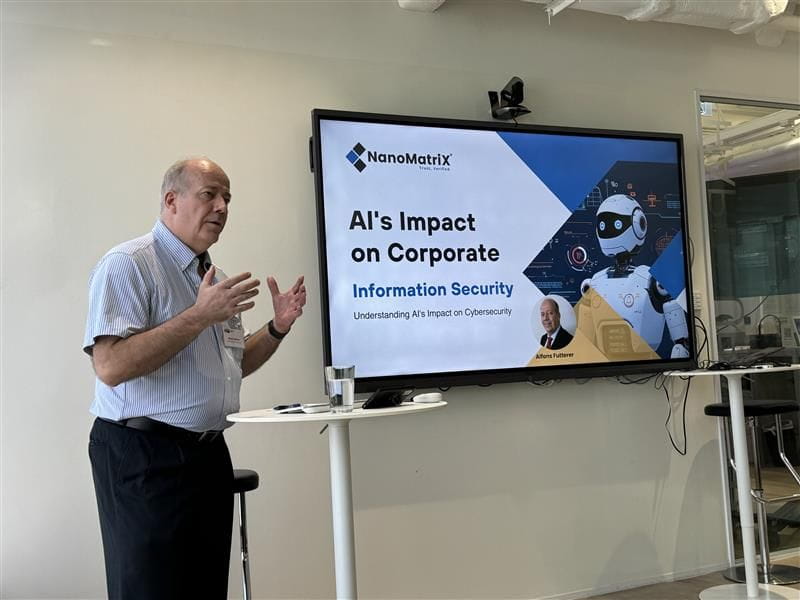
Alfons Futterer
CEO, NanoMatriX | 25+ yrs governance | ISACA
Alfons Futterer is the Managing Director at NanoMatriX Technologies, leveraging over 25 years of experience in anti-counterfeit systems, document security, and track-and-trace technologies. He is also active in AI governance, digital transformation, infrastructure-level compliance and policy implementation, and compliance innovation.

Jacqueline Gan
COO, NanoMatriX | 20+ yrs security tech | MBA Ivey
Jacqueline Gan is the Deputy Managing Director of NanoMatriX Technologies Limited, a provider of document security and authentication solutions. She has over 20 years of experience in developing and implementing design techniques and security technologies that support document protection and compliance systems for governments, central banks, and multinational corporations in Europe and Asia.
Related Articles